01. The base
What's under a patio (and why it matters)
The pavers you see are the last inch. Everything that decides whether the patio is still flat in ten years is underneath them and invisible when the job is done.
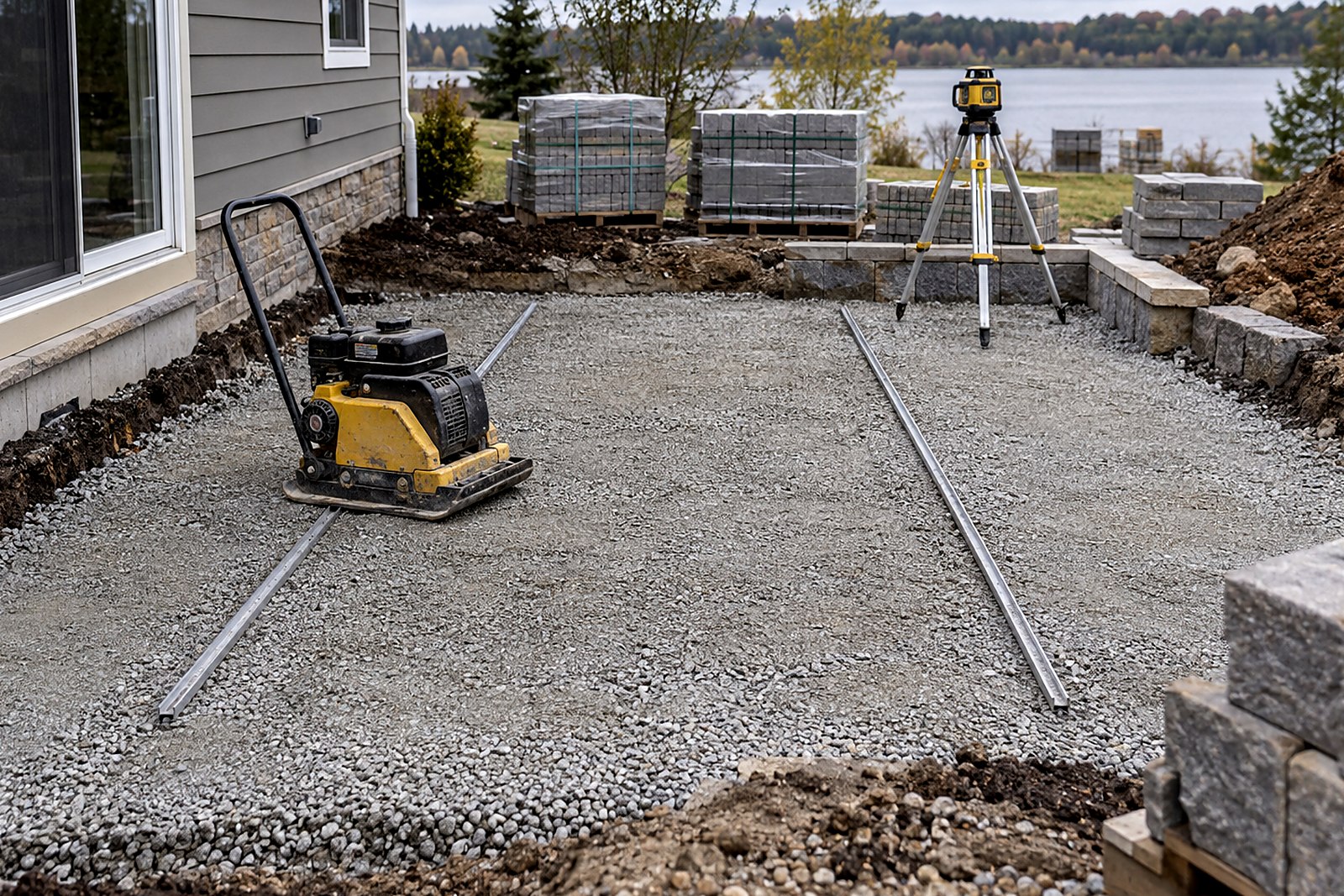
Under the pavers sit the bedding layer, the crushed stone base and the depth of the dig. Each layer has a job. The dig removes soil that would move under frost and water. The base, built up in lifts and compacted between each pass, spreads the load and stays put. The bedding layer is screeded flat so the pavers sit even.
The failure mode is easy to picture. Pavers laid on dirt, or on a base dumped in one pass and never compacted, look exactly the same on day one as a job done right. It shows up the first hard winter, when a paver moves and never settles back.
Depth is not a number you can eyeball once the job is done, which is exactly why it is worth pinning down before work starts. In this part of Massachusetts we are planning the dig and the base around a 30-inch frost zone, which is deeper than a lot of people expect. A patio is shallow work in a lot of the country. Here it is not.
You can also think of the base as a sponge and a bridge at once. The crushed stone drains water sideways and down, and compacted in lifts it carries the load of everything on top without shifting. Skip the lifts, and the same stone becomes a loose pile that the pavers float on. The material is not the trick. The compaction is.
The thickness of the base is not a guess; it comes from what the patio will carry and from the soil underneath it. A patio that only takes foot traffic and light furniture needs less than one that will hold a parked car, and a yard on soft fill needs more than one on hard native ground. That is why the same square footage can be a different job from one property to the next, and why a quote without anyone looking at the soil is only a guess.
One more thing worth knowing: good base work is quiet work. There is no part of it that looks impressive in progress, and that is exactly the point. If a crew is racing to get pavers down on the first day, ask what is under them. The depth and the compaction are the whole job. The pavers are the receipt.
A simple way to check a quote is to ask for the depth in inches and the compaction in lifts. A real answer sounds like numbers: so many inches of compacted base, laid in lifts and tamped between each. If the answer is a look and a shrug, the base is a guess. The base is most of the cost and all of the longevity, so it is the one line worth getting in writing.
Ask anyone bidding: how deep are you digging, and how thick is the base? A real job has a number for both. A vague answer is an answer.
Ready when you are.
Free estimates in Mansfield and the towns around it.