Service
Stone walkway installation in Mansfield, MA
A walkway takes more traffic per square foot than any patio, and it usually sits where water wants to run. That means the same discipline as a patio in a narrower trench: dig to depth, compact the base in lifts, set the slope so the path drains, and restrain both edges.
A walkway gets laid out around the path people already take, not the one that looks neatest on paper. Watch where the grass is worn and that is usually the line. From there the width gets set by traffic: three feet is the comfortable minimum for one person, closer to four lets two pass without stepping off.
Because a path sits in the strip where water already travels, the base and the slope do more work here than on a patio. The trench gets dug to depth, the crushed base goes in and gets compacted in lifts, and the path is set to drain along its length rather than pond in the middle of a run.
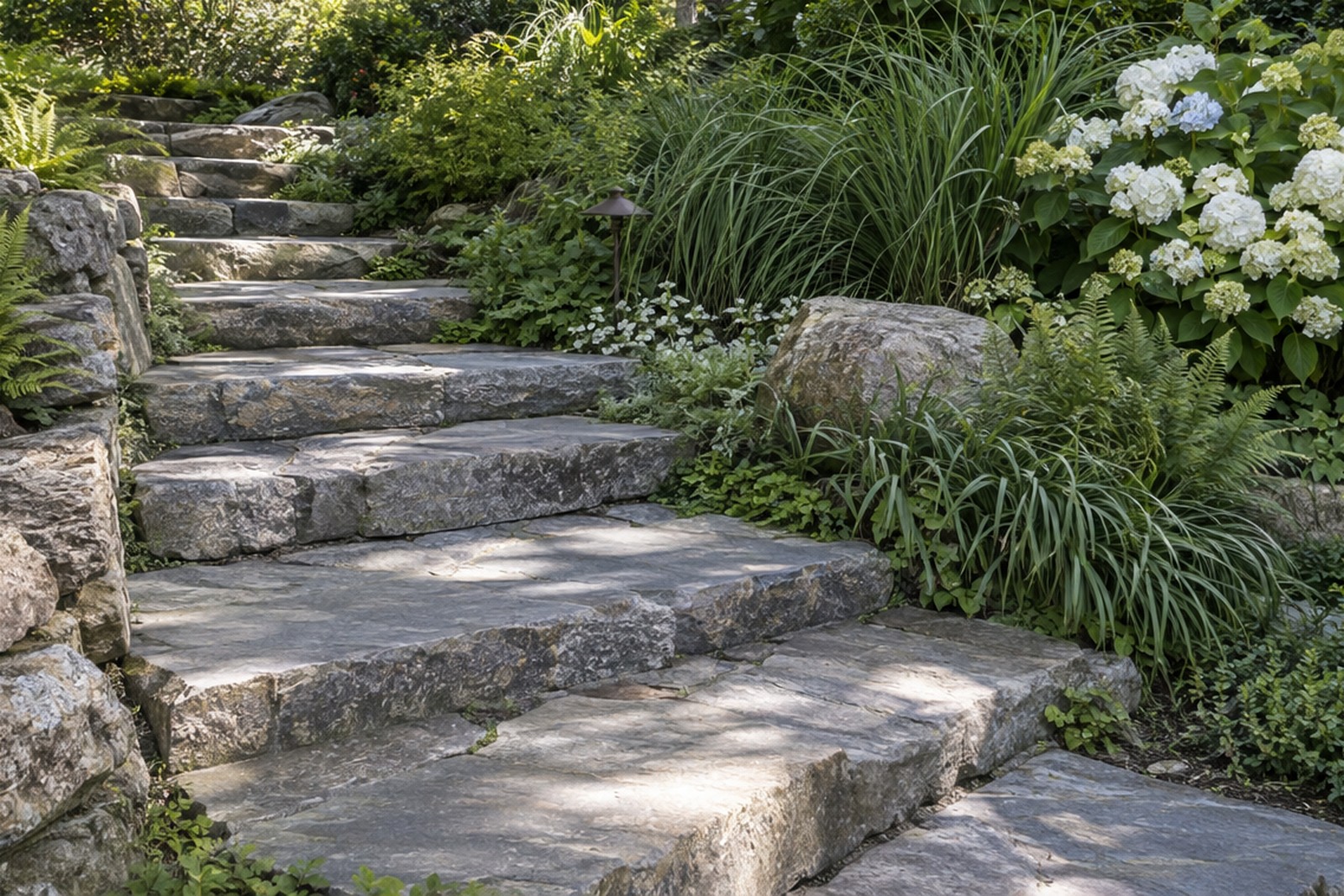
Steps and landings are where a path either feels easy or feels wrong. A comfortable rise is under seven inches with a tread deep enough to take a full stride, and landings break up a long run so it does not read as a ramp. Those get worked out with the layout, not after the stone is cut.
- Width and curve laid out around how you actually walk the yard
- Base built to the same depth as a patio, in the same lifts
- Steps and landings broken out and built to a comfortable rise
- Joints and edges detailed so the path holds its line
Common questions
Walkways & Paths questions, answered
How wide should a walkway be?
Three feet is the comfortable minimum for one person, and closer to four feet feels generous and lets two people pass. If it snows and you want it cleared easily, wider is easier.
Can you match a walkway to an existing patio?
Yes. If the stone is still available we match it, and where it isn't we lay out a path that reads as deliberate rather than mismatched. Stone and pattern are chosen together with you.
Do walkways need a base like a patio?
They do. A walkway on bare soil or a thin bed of sand looks fine the first year and then heaves and settles, usually right where water crosses it.
Planning walkways?
Tell Bryce about the yard and get a free estimate.